
📅 Last updated: 26 September 2026 • 🛡️ Checked on site: entry fee, opening hours and access details
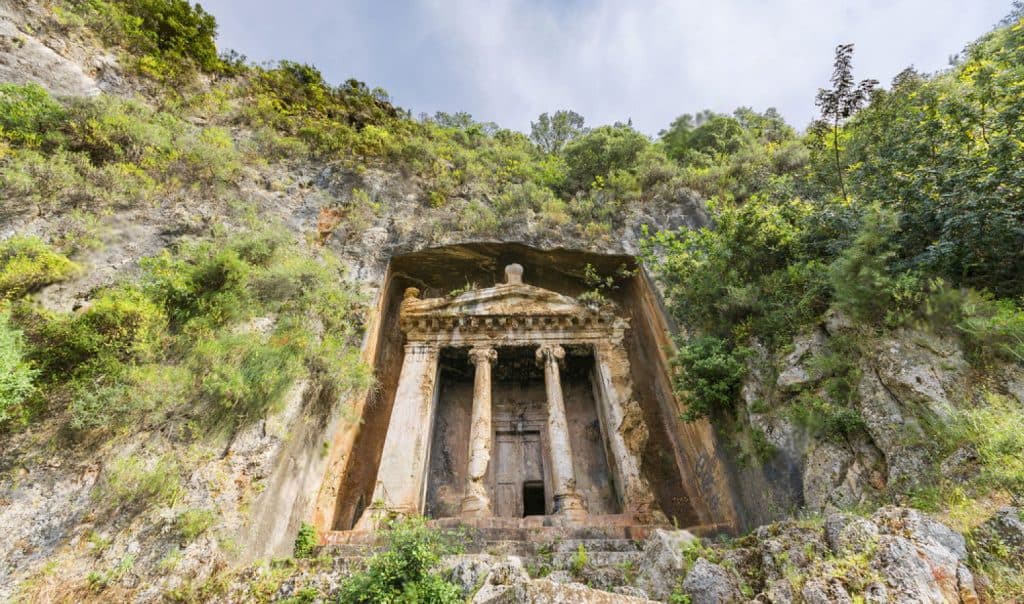
Carved into the limestone cliffs above Fethiye, the Amyntas Rock Tombs date from the 4th century BC, when the town below was still Telmessos, one of the main cities of ancient Lycia. The best known of them is the Tomb of Amyntas, with its temple-like Ionic façade high on the cliff above the bay. It is among the best-preserved in the region, and one of the few Lycian monuments you can reach on foot from the town centre.
📖 In this guide:
Amyntas, Telmessos and the Lycian Rock Tombs
The hillside above Fethiye is scattered with rock-cut tombs from the Lycian era, but the Tomb of Amyntas is the grandest, its Ionic columns carved directly out of the rock face rather than built as a free-standing porch in front of it.
Lycian rock tombs were meant to be seen. Their position high on the hillside reflected the status of those buried there, while the carved façades helped preserve the memory of the dead.
Locally it is known as Kral Mezarı, or the King's Tomb. The name Tomb of Amyntas comes from a Greek inscription carved beside the columns, still legible today and described in Look Closer: Details to Notice. Little else is recorded about Amyntas himself, and it is not certain that the monument was built for him.
How to Get to the Amyntas Rock Tombs
The tombs sit in the Kesikkapı neighbourhood, just above Fethiye town centre. They are easy to reach on foot or by car, taxi or dolmuş:
- On foot: From Atatürk Caddesi, it is an 8–10-minute uphill walk to the ticket booth. If you are starting from Paspatur (Old Town), allow about 15 minutes at a relaxed pace through the winding hillside streets.
- By car: Follow the brown "Kaya Mezarları" signs from the harbour. There is a free parking area at the base of the steps, but it is small and fills quickly in summer.
- By taxi: From Fethiye harbour or the main bus station (Otogar), the site is around a 5-minute drive.
- By dolmuş from Ölüdeniz or Çalış: Both dolmuş routes stop behind Yeni Hamidiye Camii, a 10-minute walk from the tombs. View the stop on Google Maps.
The Climb and the Upper Terrace
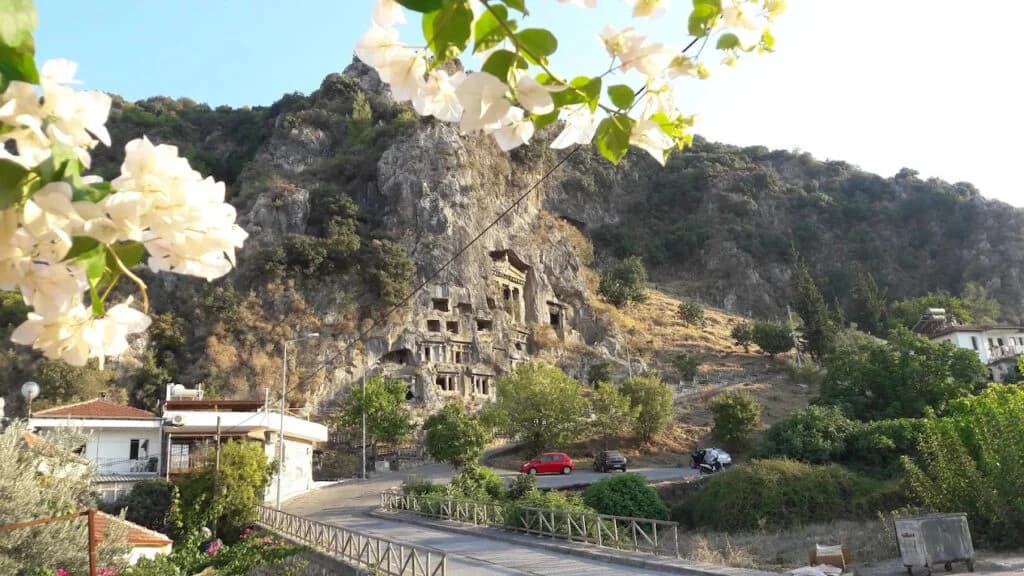
The climb to the main tomb is short, but steeper than it looks from below. There are more than 100 stone steps, with a few uneven sections, so take your time, especially on the way back down.
• Accessibility: The site is not suitable for wheelchairs or pushchairs. If you have knee, balance or mobility issues, you may prefer to view the tombs from below.
• Slippery steps: When dusty or damp, the stone steps can become extremely slippery. Wear shoes with good grip and take extra care on the way back.
• Shade and water: There is very little shade at the top. In summer, bring water and a hat, and avoid the middle of the day.
From the road, you can see the outline of the monument, but the scale and detail of the carving only become clear once you reach the upper terrace. From there, the view across Fethiye Bay, the marina and Şövalye Island opens out in front of you. Step inside the burial chamber as well, where several details repay a closer look.

Look Closer: Details to Notice
Most visitors photograph the façade and head back down. These are the things worth stopping for.
- The Amyntas inscription: On the anta (the wall projection flanking the columns) to the right as you face the tomb, roughly at eye level, the lettering reads "Amyntou tou Hermapiou", a Greek genitive meaning "[the tomb] of Amyntas, son of Hermapias". The carving is shallow, so it shows up best when the sun strikes the stone at a low angle late in the day.
- Charles Texier's mark: The French traveller Charles Texier sketched these tombs in the 19th century and carved his name into the stone. Check the upper-left corner of the façade and you may still spot it.
- The stone burial beds: Inside the chamber are the klines, the rock-cut stone beds found in most Lycian tombs. Getting in means stepping over a raised threshold about 40 cm high.
- The carved door panels: On the right as you enter, the panels show faint nail-head decoration, which is easy to overlook.
- The anta rosettes: On the upper sections of the antae you can pick out carved rosettes, originally three on each side. Those on the left have worn away, though traces survive on the right.
- The dentil course: Above the two-tiered architrave runs a row of small rectangular blocks known as a dentil course, a decorative element more commonly seen on free-standing temples than on rock-cut tombs.
As you walk back down, you will pass the smaller burial chambers on your right, still within the ticketed area. Few people stop here, though a look around takes only a couple of minutes. The carving is plainer, some chambers have no columns at all, and this corner of the site feels quieter than the terrace above.
Timing & Photography
The façade faces west, so late afternoon light usually works best for photos. In the morning, the main tomb often sits in shadow, and in summer the midday light is harsh.
In summer, aim to arrive between about 17:30 and 19:00. The last entry is at 19:30 and sunset falls after the site has closed, so plan around closing time rather than the sunset. Outside the summer season the site closes earlier, so bring your visit forward accordingly.
- Crowd tip: Early morning is the quietest time to visit, though the light will not be ideal.
- Best angle: Move slightly off-centre in front of the tomb for a cleaner view of the columns.
- Wide shots: A wide-angle lens or your phone's panorama mode works well for fitting both the tomb and the bay into one shot.
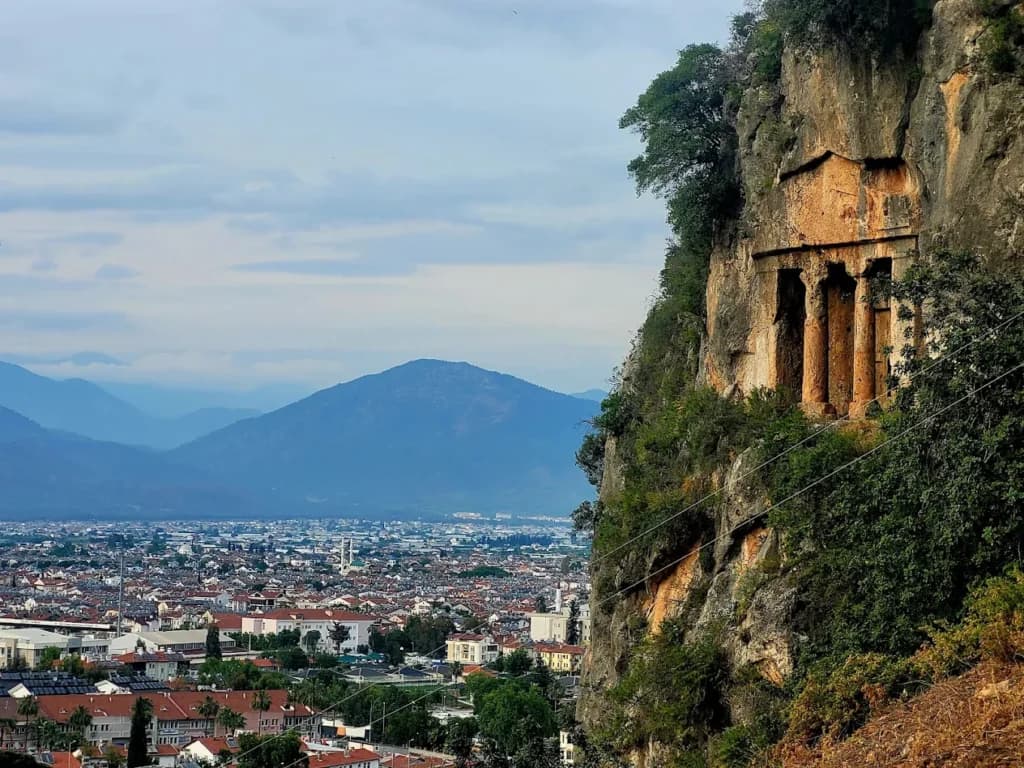
After your visit, walk down through the narrow lanes of the Kesikkapı neighbourhood towards Paspatur (Old Town), where the cafés near the harbour are a good place to stop for a Turkish coffee or a cold drink.
What to Combine with a Visit to the Tombs
The harbour, the fish market and the seafront restaurants are all within a short walk of the site, so it is easy to carry on into town afterwards. If you have your own transport, Kayaköy Ghost Town makes a good second stop. Our Fethiye Highlights Tour takes in the tombs along with the other main sights in and around the town. If you would like help planning a longer day out, send us a message on WhatsApp.
Frequently Asked Questions About the Amyntas Rock Tombs
What is the entry fee for the Amyntas Rock Tombs?+
In 2026, entry costs the Turkish-lira equivalent of €3. Check the amount at the ticket booth before paying, as the lira price is set by the day's exchange rate. Visitors without Turkish residence should ask about the Museum Pass Türkiye; the Müzekart is only for Turkish citizens and residence permit holders.
What are the opening hours of the Amyntas Rock Tombs?+
In summer, the site is usually open 08:30–20:00, with last entry around 19:30. Hours are shorter in winter, so check the closing time before you set off, or ask at the ticket booth when you arrive.
Can you see the Amyntas Rock Tombs without paying or climbing?+
Yes. The tombs are clearly visible from the street below, so you can take photos without entering the ticketed area, though the upper terrace brings you much closer to the main façade.
Is it worth climbing to the Amyntas Rock Tombs?+
Yes, if steep steps are not a problem. The upper terrace is the only place you can see the carved detail up close.
How many steps are there to the Amyntas Rock Tombs?+
More than 100 stone steps lead up to the upper terrace. Some sections are uneven, and the stone can be slippery when dusty or damp, so wear shoes with a decent grip.
How long should I allow for a visit?+
Most visits last 45–60 minutes, which is enough time to climb, take photos and enjoy the view.
Is the site suitable for wheelchairs or pushchairs?+
No. Steep stone steps and uneven ground lead up to the upper terrace, so it is not suitable for wheelchairs or pushchairs. Those who find steps difficult can still see the tombs from street level.
What is the best time to visit the Amyntas Rock Tombs?+
Late afternoon. The façade faces west, so it catches warmer light later in the day.